
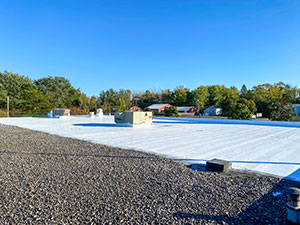
Liquid applied roofing may restore a commercial roof in Glasgow, KY by curing into a bonded, seamless membrane over the existing surface, but only when the roof underneath is a sound candidate. A coating is suitable only when underlying materials are sound and dry, the existing roof is securely attached, drainage is acceptable, and a compatible system is specified. It does not repair wet insulation, rotted decking or ponding caused by a drainage defect.
Commercial Roofing Pros applies liquid roofing systems for commercial buildings in Glasgow. This guide explains how to tell whether your roof is a good restoration candidate, which conditions rule coating out, and how preparation, application and acceptance should be handled. To talk through your roof, call (857) 663-7767.
What Liquid Applied Roofing Does and Does Not Do
A liquid-applied system is rolled, brushed or sprayed onto a prepared roof and cures into a continuous membrane. Across the open field of the roof there are no sheet seams, which removes one common leak point. It conforms to skylights, curbs, equipment supports and irregular shapes, and it can often be applied without a tear-off, which limits debris and disruption to the building.
It does not remove every weak point. Flashing, terminations, laps in any reinforcing fabric, penetrations and edges still depend on careful detailing. A coating also bonds to whatever is under it, so the condition of the existing roof decides how well the restoration performs. For general information about coating options, see our commercial roof coatings page for Glasgow.
Is the Existing Roof a Sound Restoration Candidate?
Five conditions largely decide whether liquid applied roofing is the right restoration choice. The table shows what each condition means and how it is usually checked.
| Condition | How it is checked | If the finding is favorable | If the finding is unfavorable |
|---|---|---|---|
| Moisture | Visual review, interior leak history and moisture screening such as thermal imaging, confirmed where needed | Insulation is dry, or wet spots are small and can be replaced | Wide-area wet insulation: coating is not appropriate until it is removed |
| Adhesion | Inspection for blisters, loose areas and peeling, plus test areas where appropriate | Surface is firmly bonded and cleans up well | Widespread delamination: the coating would only be as secure as the layer under it |
| Substrate condition | Review of membrane, metal panels, fasteners, seams and deck | Surface is intact, or defects can be repaired first | Rotted decking or corroded-through panels need repair or replacement |
| Drainage | Slope, drains, scuppers and evidence of standing water after rain | Water leaves the roof, or blockages can be cleared | Structural low spots that hold water: the cause must be corrected, as coating will not fix it |
| Compatibility | Identification of the existing roof type and review of primers and coating systems for that surface | A suitable system is available for the existing roof | No coating will bond reliably to the existing material |
When several conditions come back unfavorable, repair or replacement is usually the better path. Our flat roof restoration page for Glasgow covers restoration as a broader option, and the commercial roof repairs page for Glasgow covers localized repair.
Conditions That Make Coating Inappropriate
- Saturated insulation. Coating over wet insulation traps moisture and allows damage to continue under the new surface.
- Rotted or deteriorated decking. The structure must be sound before any surface treatment.
- Ponding from drainage defects. A coating does not change the slope or fix blocked or missing drains.
- Extensive delamination or loss of adhesion. The coating cannot be better bonded than the layer beneath it.
- Roofs at the end of their service life. If the roof is failing everywhere, restoration only delays replacement.
Preparation, Repairs and Application
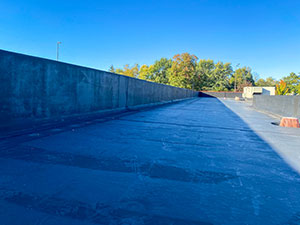
Most coating problems start with preparation. A well-run project usually follows these steps.
- Inspection: a commercial roof inspection in Glasgow documents moisture, adhesion, drainage and details before a scope is written.
- Cleaning: dirt, mildew, loose granules and residue are removed so the coating can bond.
- Repairs: open seams, splits, loose fasteners and failed flashing are corrected before coating.
- Primers and detail work: primers or bonding coats are used where the existing surface requires them, and penetrations, seams and edges are reinforced first.
- Application: the coating is applied in the specified number of coats and thickness. Application and curing need weather conditions within the specified product limits for temperature, humidity and precipitation. Check the forecast and written specification before scheduling work.
Coating chemistries differ. Acrylic, silicone and polyurethane systems behave differently with ponding water, foot traffic and surface type, so the contractor should explain why the selected product suits the existing roof.
Application Acceptance and Follow-Up Inspection
Before accepting the project, ask the contractor to document completion checks. Qualified roofing personnel should check for full coverage at seams, penetrations and edges, uniform thickness, no pinholes or uncured areas, and clear drains. Ask for documentation of the products used and the work performed. A follow-up inspection after the first season and routine inspections afterward help catch wear early, and the roof maintenance program for Glasgow covers routine inspections and seasonal preparation.
Realistic Expectations on Lifespan, Reflectivity and Savings
A coating can extend the service life of a sound roof, but how much depends on the existing roof, the system, the thickness applied, drainage and maintenance, so no fixed number of added years can be promised. Reflective coatings can reduce the heat a roof absorbs and may ease cooling demand, though actual savings depend on insulation, HVAC equipment and building use, and reflectivity can decline as dirt accumulates. Restoration often involves less tear-off than replacement, but preparation and repairs still affect cost and schedule, so compare written scopes rather than price alone.
Liquid Applied Roofing Professionals in Glasgow, KY
Commercial Roofing Pros serves commercial property owners in Glasgow, KY. If you are weighing coating, repair or replacement, call (857) 663-7767 and describe the roof type, its age and any leaks or ponding you have noticed.
Frequently Asked Questions
Can liquid applied roofing be used on any commercial roof?
No. It suits roofs with dry underlying materials, secure attachment, sound decking and verified coating compatibility. Wet insulation, rotted decking and widespread delamination rule it out until corrected.
How long does a liquid applied roofing system last?
It depends on the existing roof, the coating system, thickness, drainage and maintenance. No fixed number of years can be promised without assessing the roof.
Is installation disruptive to building operations?
Coating over an existing roof avoids tear-off, which reduces debris and disruption, but access, noise, odors and weather delays still need to be planned with the contractor.
Does liquid applied roofing help with energy efficiency?
Some reflective coatings can reduce heat absorbed by a roof and may ease cooling demand. The actual effect depends on insulation, HVAC equipment and how the building is used.