
An energy efficient roofing upgrade can improve a commercial building’s thermal performance, but the result depends on more than roof color. For a Bowling Green, KY facility, reflectance, insulation, and air leakage should be evaluated as separate factors before anyone estimates savings. Call (857) 663-7767 to discuss the condition of your roof and building.
Three Factors That Affect Roof Energy Performance
Reflectance describes how much incoming solar energy a roof surface reflects instead of absorbing. A more reflective roof surface can reduce roof-surface temperatures during sunny conditions, but that does not by itself show how much energy the entire building will save.
Insulation controls heat flow through the roof assembly. Its effect depends on the amount, type, continuity, and condition of the insulation already in place. A reflective membrane over a poorly insulated roof may still leave substantial heat transfer through the assembly, while additional insulation can change performance even when the exterior roof color stays the same.
Air leakage is a different issue. Gaps in the building envelope can allow conditioned air to escape and outside air to enter. Roofing transitions, penetrations, curbs, edges, and adjoining wall conditions may be part of that picture, but identifying the actual leakage path can require investigation beyond a visual roof inspection. These factors should be evaluated separately.
Reflective Roofing and Coatings
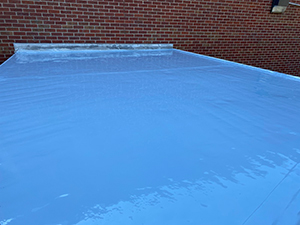
Commercial Roofing Pros currently lists acrylic roof coatings and single-ply installation that includes TPO and PVC. Reflective coatings and light-colored membranes can reduce solar heat absorbed at the roof surface when the selected system has appropriate reflectance properties.
Do not assume that every coating, TPO product, or PVC membrane has the same reflectance, or that the roof’s initial reflectance will stay unchanged over time.
Insulation Has Its Own Role
Insulation should be reviewed independently from the membrane or coating. The contractor should identify what insulation is already present when that information is available, whether wet or damaged insulation is suspected, and whether the proposed work includes adding, replacing, or leaving insulation in place.
The energy effect is building-specific. HVAC type, occupancy, operating hours, internal heat loads, air leakage, and local weather all influence the amount of heating or cooling energy a roof improvement may save.
Do Not Assume a Roof Upgrade Fixes Air Leakage
Air leakage can reduce the benefit of reflective roofing or added insulation, but it should not be diagnosed from a roof surface alone. Leakage can also come from walls, doors, mechanical systems, or other parts of the building envelope.
If air leakage is part of the energy concern, ask what evidence supports the suspected leakage path and whether another building-envelope or mechanical evaluation is appropriate. A roofing proposal should clearly distinguish roofing work from other work that may be needed to address whole-building leakage.
Utility Savings Need Project-Specific Evidence
No single percentage or dollar figure applies to every energy-efficient roof. A Bowling Green building with dark roofing, limited insulation, long cooling hours, and substantial solar exposure may respond differently from a building with good insulation, lower internal loads, or limited cooling demand.
Any savings estimate should state the assumptions behind it. If those inputs are not known, the proposal should describe the likely performance direction without presenting a precise savings figure as established fact.
HVAC Wear and Indoor Comfort
Reducing heat transfer or unwanted air leakage can reduce cooling demand in some buildings and may help indoor temperatures remain more stable. That does not guarantee longer HVAC equipment life. Equipment age, sizing, controls, maintenance, runtime, and mechanical condition all affect wear.
Hot or cold areas can also result from ductwork, ventilation, controls, glazing, or occupancy patterns.
Retrofit Versus Replacement
An existing roof does not always need full replacement to improve energy performance. Depending on roof condition and system compatibility, a coating or membrane-related retrofit may be worth evaluating. Wet insulation, failed substrate, drainage problems, or widespread deterioration can change the scope.
Commercial Roofing Pros also has energy efficient roofing information for another Kentucky market and a broader single-ply systems overview.
What to Ask for in an Energy-Focused Roofing Proposal
Ask the contractor to document the existing roof condition, the proposed roof system, expected reflectance characteristics, insulation changes, known moisture concerns, and any assumptions about air leakage. It should also identify inclusions, exclusions, and findings that could change the scope.
If energy savings are part of the recommendation, ask what building data supports the estimate. Retain product information, insulation documentation, and completed-scope records for later evaluation.
Energy Efficient Roofing in Bowling Green, KY
For a Bowling Green commercial building, energy performance should be evaluated as a combination of roof-surface reflectance, insulation, air leakage, HVAC operation, and building use. Commercial Roofing Pros can be reached at (857) 663-7767 to discuss roofing conditions and the options that fit the existing assembly.
Frequently Asked Questions
What makes a commercial roof energy efficient?
Reflectance, insulation, and air leakage all matter, but they affect performance in different ways. HVAC operation and building use also influence the final result.
Will a reflective roof automatically lower utility bills?
No. A reflective surface can reduce solar heat absorption, but actual savings depend on insulation, HVAC condition, operating hours, climate, and other building factors.
Can an existing commercial roof be upgraded instead of replaced?
Sometimes. Retrofit suitability depends on roof condition, moisture, substrate stability, drainage, compatibility, and the requirements of the proposed system.
Does energy-efficient roofing extend HVAC equipment life?
Reduced cooling demand may lower runtime in some buildings, but equipment life also depends on age, sizing, controls, maintenance, and mechanical condition.