

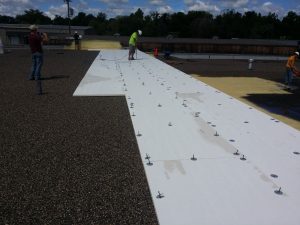
 Lebanon sits in Marion County at the center of Kentucky agricultural and light commercial activity, and the flat roofs on its warehouses, processing buildings, and retail space have a lot in common. Most of them are candidates for the same system. TPO roofing has become the default single-ply choice on commercial buildings across the region, and at Commercial Roofing Pros we install it more than anything else.
Call Commercial Roofing Pros at (857) 663-7767 for TPO roofing in Lebanon, KY.
Why Kentucky Buildings Choose TPO Roofing
TPO is a thermoplastic membrane, meaning it softens with heat and can be fused. That single property drives most of its advantages, starting with how the sheets are joined.
Central Kentucky gives a roof a full workout. Summers run hot and humid, spring brings heavy rain, and winter cycles the surface across freezing again and again. A membrane here has to reflect heat, shed water, and flex through temperature swings without giving up its seals. TPO does all three, which is why it appears on so many Lebanon buildings.
Heat-Welded Seams Make One Continuous Surface
Adjacent TPO sheets are joined with hot air. The tool heats both surfaces until the material flows, and pressure fuses them into one mass of membrane.
A properly welded seam is stronger than the sheet on either side of it. Pull-test a good weld and the membrane tears before the seam does. That is a different situation from adhesive-set systems, where the bond is a separate material holding two sheets together and the adhesive is the part that ages.
Welds get verified, not assumed. A probe run along the finished seam finds voids and cold welds, and any section that fails gets rewelded before the crew moves on. On a roof with thousands of feet of seam, that check separates a twenty-year roof from a warranty claim.
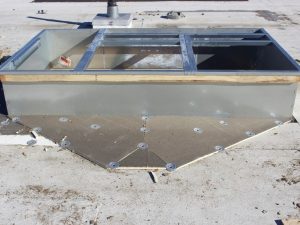 TPO Roofing Has A Reflective Surface That Works!
The white TPO surface reflects a large share of the solar energy hitting it. The membrane runs cooler, the assembly below runs cooler, and cooling equipment works less to hold the same indoor temperature.
For food and agricultural facilities around Lebanon, where refrigeration and temperature control are part of the operation rather than a comfort item, that reduction shows up every hot month. Retail and light industrial buildings see it as lower summer cooling demand.
The reflective surface also slows how fast the membrane itself ages. Heat drives most of the chemical breakdown in roofing materials, so a cooler membrane stays intact longer.
TPO Roofing Service Life
TPO is manufactured with UV stabilizers built into the top layer, the part that faces decades of direct sun. Without them, sun exposure would break down the surface long before anything else failed.
Temperature cycling is the other slow stress. A Kentucky roof swings widely between a January night and a July afternoon, and the membrane expands and contracts every day of that. TPO stays flexible across the range, and because the seams are fused rather than glued, thermal movement pulls on continuous material instead of on a bond line.
Membrane thickness affects how long all of it holds. Thicker membranes take foot traffic and equipment service better. On buildings where crews are on the roof regularly, that thickness is the difference between a membrane that wears and one that punctures.
TPO Roofing Suits the Buildings Around Lebanon
Fused seams, a reflective surface, and material that handles the swing between a Kentucky August and a Kentucky January add up to a system that fits the local building stock well. TPO roofing does not suit every roof, though on flat and low-slope commercial buildings in this part of the state it is usually the first system worth pricing.
For TPO roofing in Lebanon, KY, contact Commercial Roofing Pros at (857) 663-7767 today.
FAQ
How long does a TPO roof last on a Kentucky commercial building?
Well-installed TPO commonly runs 20 to 30 years, with membrane thickness, seam quality, and drainage doing most of the work in deciding where a given roof lands.
Does TPO come in colors other than white?
Gray and tan are available, though white stays the standard commercial choice because it reflects the most heat.
Can TPO be installed over an existing roof?
Sometimes, if the deck is sound, the existing membrane is dry, and local code allows the number of layers involved. A moisture survey answers that before anything is ordered.