

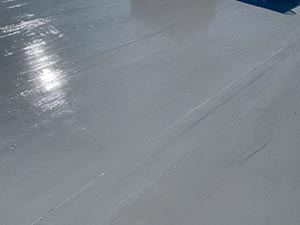
Campbellsville is a working town, and the plants and warehouses around Taylor County carry acres of low slope roof between them. Those roofs wear out on their own schedule, which rarely suits the business underneath. A rubber roof coating gives owners a way to restore that roof without pulling it off.
Call Commercial Roofing Pros at (857) 663-7767 for rubber roof coating in Campbellsville, KY.
Rubber Roof Coating and Rubber Membrane Are Different
Owners hear rubber and picture EPDM, the black sheet membrane rolled out and fastened down as the roof itself. That sheet is the roof. A rubber roof coating is a liquid applied over a roof that is already there, and it cures into a seamless waterproof skin across the whole surface.
One replaces the roof. The other renews it. That gap is the difference between a tear off, with open decks and dumpsters in the lot, and a few days of surface work with the building running normally underneath.
Coatings go over most low slope systems, and what the roof is made of decides how the coating gets used.
The Roof Underneath Sets the Rubber Roof Coating
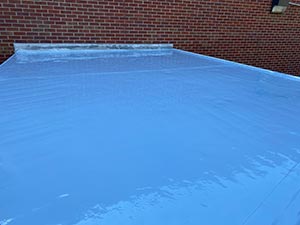
On a single ply membrane that still has life in it, coating is preventive. The membrane keeps water out, but the surface has chalked and the seams have started to pull. A coating restores it, adding years of service the roof might not otherwise have had.
An aging modified bitumen or built up roof is a restoration job instead. Asphalt fails by drying out. The oils bake off, the surface crazes into fine cracks, and the granules wash into the drains after every storm. An elastomeric coating, meaning one that stretches and recovers, moves with that surface and bridges the cracks instead of sitting on top of them.
Condition points to the product, so the next question is which coating belongs up there.
Silicone, Acrylic, and Elastomeric Coatings
Three chemistries cover most commercial flat roofs in Kentucky, and each answers a different problem.
Silicone holds up to standing water better than the rest, which earns it a place on the older, slow draining roofs that keep puddles in the low spots for days after a storm. Acrylic reflects heat and keeps the surface cooler through a humid Kentucky summer, and it performs best where the roof drains cleanly. Elastomeric systems stay flexible through the freeze and thaw swings this region delivers every winter, moving with the roof rather than cracking as it shifts.
Choosing between them requires an inspection, not a catalog. And the best product still fails on a badly prepared surface.
How a Rubber Roof Coating is Applied
A coating bonds to whatever it touches, so if it touches dirt, it comes off with the dirt. The roof is washed down first, then damaged areas and open seams are repaired. Only after that does the coating go on, usually in more than one pass, curing into a continuous layer across the field and into every seam, curb, and penetration. Water finds joints, and a surface without joints gives it nowhere to go.
The step owners rarely hear about is the moisture check. Wet insulation does not dry out once a coating seals it in. It keeps working on the deck beneath a roof that looks brand new, which is why a candidate roof is scanned and saturated sections come out before anything is sprayed.
Rubber Roof Coating Specialists
A coated roof is also renewable. As the warranty period runs down, the roof is cleaned and recoated, coverage starts over, and service life is extended again at a fraction of the cost of another tear-off. A rubber roof coating restores an aging commercial roof and pushes replacement further out, with no tear-off and no shutdown below.
For rubber roof coating in Campbellsville, KY, contact Commercial Roofing Pros at (857) 663-7767 today.(857) 663-7767
FAQ
What time of year can a commercial roof be coated in Kentucky?
Spring through fall. The roof has to be dry, and temperatures need to hold above roughly 50 degrees for a proper cure.
Does a roof coating add weight to the building?
Very little. It adds a fraction of the load a second roof system would, which matters on older decks near their limit.