

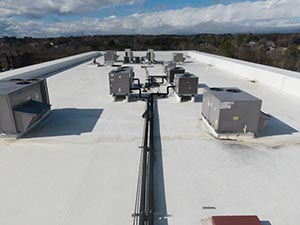
Elizabethtown has a significant amount of flat roof area, from retail and light industrial space to the distribution facilities that sit near the I-65 corridor. Those roofs are tested every time a storm crosses the region, and those that perform well were properly sealed from the start. A TPO roof installation done right turns a flat roof into a single continuous waterproof surface.
For related commercial roofing guidance in Elizabethtown, see commercial roofers in Elizabethtown.
Call Commercial Roofing Pros at (857) 663-7767 for TPO roof installation in Elizabethtown, KY.
TPO Roof Installation Creates One Sealed Surface
TPO is a single-ply membrane, meaning the roof is waterproofed by one layer of sheet material rather than several built-up layers. The sheets arrive in rolls, commonly 10 or 12 feet wide, and are joined together on the roof.
How those sheets are joined is critical to the system’s performance. Heat welding melts the two sheets together at the overlap, so the seam becomes part of the membrane instead of a joint held closed by something else.
Membrane thickness is also an important consideration. Membranes are specified in mils, usually 45, 60, or 80, and the heavier sheets resist punctures from foot traffic and hail while giving the welder more material at every seam.
Heat-Welded Seams Behave Differently Than Adhesives
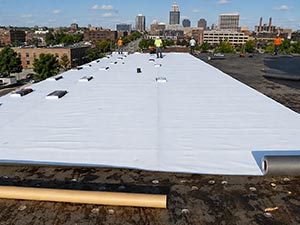
A welded seam does not rely on a separate bonding material, which can help it outlast a glued or taped seam. Done at the correct temperature and speed, the weld is as strong as the sheet on either side of it.
Adhesives and lap tapes hold two separate pieces together, and every bonded joint has a service life shorter than the material it joins. Heat, cold, and daily movement can gradually weaken that bond.
Weld quality can be verified before anyone leaves. Running a probe along the seam can identify areas that did not fully fuse, which is why seam testing should be part of the installation process rather than something addressed after the first leak.
TPO Roof Installation Fails on the Details
Most flat roof leaks start at transitions rather than in the open field of the membrane. Drains, curbs, pipe penetrations, and the perimeter edge are where the membrane has to stop and connect to something else.
Each transition requires specific attention. Drains need a proper clamping ring with membrane seated flat into the bowl, curb flashing has to run high enough to stay above standing water, and pipes need welded boots rather than sealant alone.
Rushing these transitions can result in a roof that looks finished but develops leaks within a few years. Careful attention to these areas helps reduce the risk of premature leaks.
Slope and Drainage in TPO Roof Installation
Water that remains standing 48 hours after rainfall is a drainage problem the membrane cannot solve. TPO handles occasional ponding well, though no membrane is built to sit under water permanently.
Elizabethtown sees rainfall spread through most of the year, so a roof that drains slowly stays wet. Constant moisture exposure can stress seams and accelerate dirt buildup, which can reduce the reflectivity that makes white TPO an attractive roofing option.
Correcting slope with tapered insulation, adding drains, or clearing blocked scuppers during installation is far simpler than revisiting the problem with a finished roof in place.
TPO Roof Installation Professionals
A watertight flat roof comes from welded seams, carefully flashed transitions, and drainage that works. These are important installation decisions that can influence the roof’s long-term performance.
With nearly two decades of experience working on commercial buildings throughout Kentucky, our crews are trained and certified on the systems we install, and every roof goes into a maintenance program that keeps its warranty intact. For TPO roof installation in Elizabethtown, KY, contact Commercial Roofing Pros at (857) 663-7767 today.
FAQ
How long does a TPO roof last on a commercial building?
Most TPO systems are rated for 20 to 30 years, depending on membrane thickness and installation quality. Thicker membranes hold up better under foot traffic and hail.
Can TPO be installed over an existing flat roof?
Sometimes, if the existing roof is dry and structurally sound and local code allows a second layer. A moisture scan determines whether a tear-off is needed first.
What causes a new TPO roof to leak?
Common causes include a seam that was not fully welded or an improperly completed flashing detail at a drain, curb, or penetration. Punctures from dropped tools or equipment service are other common sources of leaks.