

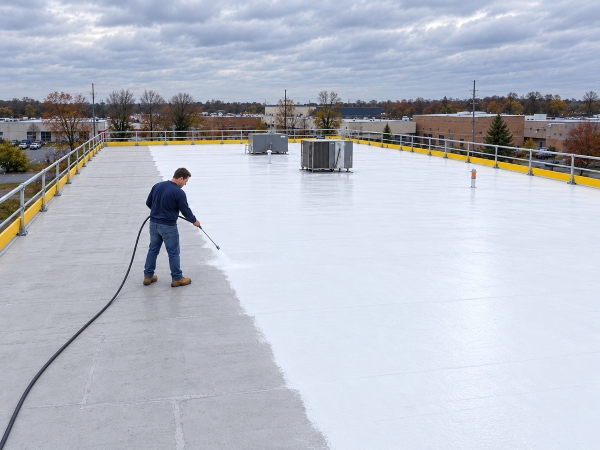
Flat roof sealing in Bowling Green, KY can be appropriate when a commercial roof has localized seams, flashing, penetrations, or small surface defects that can be repaired with materials compatible with the existing system. It is not a substitute for correcting wet insulation, damaged substrate, widespread membrane deterioration, or drainage problems.
Commercial Roofing Pros provides commercial roof repair, coatings, single-ply roofing, and spray foam services in Kentucky. For a Bowling Green property owner, the useful question is whether the roof needs targeted sealing, a broader coating or foam restoration scope, a defined repair, or further investigation before any surface treatment is selected.
What Flat Roof Sealing Usually Means

The word sealing can describe several different types of work. On one roof it may mean repairing an open seam or resealing a flashing detail. On another, it may refer to preparing and coating a larger roof area. The correct scope depends on the roof system, the defect, and the condition of the materials around it.
Targeted sealing is most appropriate when the problem is limited and the surrounding roof remains serviceable. A sealant or patch should be selected for compatibility with the existing membrane, coating, metal, or built-up roof rather than treated as a universal product that works everywhere.
Common Areas That Need Closer Review
Many leaks develop at transitions and interruptions in the roof rather than across an undisturbed field area. Common places to investigate include:
- Seams and laps: joints that have opened, lifted, separated, or deteriorated.
- Flashing: roof-to-wall transitions, curbs, parapets, and other details where the roof changes direction.
- Penetrations: pipes, vents, equipment supports, and other openings through the roof assembly.
- Surface damage: punctures, cuts, cracks, or worn areas caused by weather, traffic, debris, or prior work.
- Drainage areas: drains, scuppers, gutters, low spots, or other locations where water repeatedly collects.
A visible defect does not automatically prove it is the only leak source. Water can move within the roof assembly before it appears inside the building, so the repair should follow the evidence rather than the nearest ceiling stain.
Sealing, Coating, Foam, or Larger Repair?
The table below is a decision guide, not a diagnosis. The same symptom can lead to different scopes depending on what is found during the assessment.
| Approach | When It May Fit | What Can Change the Decision |
|---|---|---|
| Targeted sealing | A limited seam, flashing, penetration, or small surface defect can be corrected and the surrounding roof remains serviceable. | Repeated failures, incompatible prior repairs, suspected moisture, or deterioration beyond the isolated detail. |
| Roof coating | The existing roof is a suitable restoration candidate after repairs and surface preparation. | Wet materials, unstable substrate, poor adhesion, incompatible surfaces, or drainage conditions that coating does not correct. |
| Spray foam system | The roof and building conditions are suitable for the proposed foam and protective coating system. | Moisture, substrate condition, surface preparation, drainage, or compatibility issues that prevent an appropriate installation. |
| Larger repair | Membrane, flashing, insulation, or other damaged materials need removal or replacement in a defined area. | Broader deterioration or repeated problems may justify comparing restoration or replacement rather than continuing isolated repairs. |
Commercial Roofing Pros’ page on commercial roof coatings in Bowling Green, KY covers the coating route in more detail, while its spray foam roofing in Bowling Green, KY page addresses that separate system.
Moisture Changes the Sealing Decision
An interior stain, active drip, or soft ceiling material can indicate water entry, but it does not show how far moisture has traveled within the roof assembly. Surface observations should be separated from confirmed concealed moisture.
Commercial Roofing Pros lists thermal scanning among the tools used during roof inspections. Thermal patterns can help identify areas that may warrant closer investigation, but a thermal scan should not be described as proof of wet insulation by itself. The findings need to be interpreted with the roof construction, weather conditions, surface observations, and any additional investigation that may be appropriate.
The company’s commercial roof inspection in Bowling Green, KY page provides related inspection context.
Drainage Problems Need Their Own Solution
Sealing a seam or coating the roof surface does not automatically correct poor slope, blocked outlets, low areas, or other drainage conditions. If water repeatedly collects in the same place, the contractor should determine whether the issue involves debris, drain condition, outlet elevation, roof slope, settlement, or another cause.
A surface repair may still be needed in the affected area, but the drainage condition should be addressed on its own terms so the same stress is not left in place after the repair.
Surface Preparation Is Part of the Repair
Sealants, tapes, patches, coatings, and other repair materials depend on proper preparation. Dirt, oxidation, moisture, loose material, failed old sealant, previous coatings, and incompatible repair products can interfere with adhesion.
The proposal should explain how the area will be cleaned and prepared, what materials are being used, and why they are compatible with the existing roof. Weather and surface-condition limits also depend on the selected product, so temperature or recent rain requirements should come from the actual repair system rather than a generic rule.
When a Larger Repair Makes More Sense
A larger repair may be appropriate when damage extends beyond one seam or flashing detail, when insulation or substrate must be removed in a defined area, or when repeated patches have not resolved the underlying problem.
Commercial Roofing Pros’ commercial roof repairs in Bowling Green, KY page covers that broader repair path. Replacement is not automatic simply because a roof has repeated leaks, but widespread deterioration, broad moisture concerns, or repeated failures across several roof areas are reasons to compare a larger scope before approving another localized seal.
Questions to Ask Before Sealing Begins
A clear proposal should make the scope understandable before work starts. Useful questions include:
- What roof system is installed now?
- Which specific seams, flashing areas, penetrations, or surface defects are being repaired?
- What evidence supports the conclusion that the problem is localized?
- How was concealed moisture evaluated, and what remains uncertain?
- What preparation is required before the sealant, patch, coating, or foam is applied?
- Are the proposed materials compatible with the existing roof and prior repairs?
- Does drainage require separate corrective work?
- What conditions could change the scope after work begins?
Flat Roof Sealing in Bowling Green, KY
Commercial Roofing Pros has more than 18 years of roofing experience and serves commercial buildings across Kentucky. For a Bowling Green flat or low-slope roof, sealing should be selected only after the defect, surrounding roof condition, moisture concerns, drainage, and material compatibility are understood.
Property owners can contact Commercial Roofing Pros at (857) 663-7767 to discuss whether targeted sealing, a coating or foam restoration system, or a larger repair is the appropriate next step for the roof.
Frequently Asked Questions
Is flat roof sealing a permanent fix?
It can be a durable repair when the defect is localized, the materials are compatible, and the surrounding roof remains serviceable. It is not a solution for unresolved moisture, substrate, or drainage problems.
What is the difference between sealing and coating a flat roof?
Sealing usually addresses specific seams, flashing, penetrations, or small defects. A coating is applied across a larger prepared roof surface as part of a restoration scope.
Can every commercial flat roof be sealed?
No. The repair method depends on the existing roof system, surface condition, moisture, drainage, compatibility, and the extent of the defect.
Can thermal scanning prove that insulation is wet?
Not by itself. Thermal scanning can identify patterns that may justify closer investigation, but the findings should be interpreted with other roof evidence before moisture extent is confirmed.