
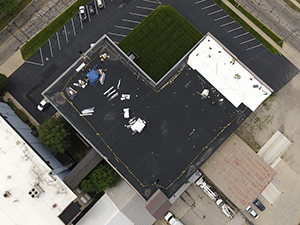
Flat roof restoration in Campbellsville, KY means keeping a sound existing roof in place and renewing its waterproofing, instead of tearing everything off. For a building with a membrane that is worn but still dry underneath, restoration can be a practical alternative to replacement. For a roof with wet insulation or a failing deck, it is the wrong tool. The difference is found by inspection, not by the age of the roof alone.
Commercial Roofing Pros works with commercial building owners across Kentucky on membrane care, coatings, repairs and replacement planning. This guide explains what restoration involves, how it compares with repair and replacement, where it stops being appropriate, and what a Campbellsville owner should expect from the process.
What Flat Roof Restoration Includes
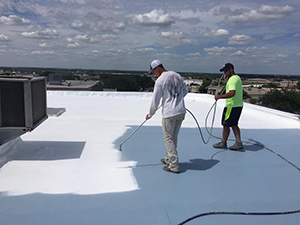
Restoration is a sequence of steps, not a single coating pass. A typical scope on a low-slope commercial roof covers:
- Documented condition review: locating blisters, open seams, cracked flashings, ponding areas and failed sealant, ideally with dated photos.
- Moisture assessment: checking whether water has reached the insulation. Confirmed wet or damaged insulation must be evaluated and addressed before any coating work proceeds.
- Repairs before coating: reinforcing seams, flashings and penetrations such as HVAC curbs, vents and skylights with compatible tapes, sealants or fabric reinforcement.
- Cleaning and preparation: removing dirt, chalking and loose material so the new coating can bond.
- Coating application: applying the specified compatible coating to the prepared surface at the required coverage and thickness.
- Final review: walking the finished roof to confirm details, edges and drains are complete.
Skipping repair and preparation can undermine coating adhesion and performance. The coating system depends on a suitable substrate. It does not correct a wet assembly or structural problem underneath.
Restoration, Repair or Replacement
These three options solve different problems. The table below compares them for a typical flat commercial roof.
| Option | Best fit | Limits |
|---|---|---|
| Localized repair | A few defined leaks, a damaged flashing or a split seam on an otherwise healthy roof | Does not address general membrane wear across the whole surface |
| Restoration | Widespread surface wear, UV aging or minor leaks on a roof with dry insulation and a sound deck | Not suitable for saturated insulation, deteriorated decking or chronic ponding caused by structure |
| Replacement | Widespread wet insulation, a failing deck or a membrane that can no longer be repaired or coated | Larger scope and more disruption, so it is usually reserved for roofs that cannot be restored |
When a roof sits between two categories, the inspection findings decide. An owner planning a new single-ply roof system should know that restoration is not a way to avoid a replacement the building actually needs. It is a way to defer replacement when the existing roof remains a suitable restoration candidate.
Coating Choices for Flat Roofs
Coating products have different properties. The examples below describe general material categories, not a promise that Commercial Roofing Pros installs each formulation. The right product depends on the roof surface, drainage and intended system.
- Silicone: some products tolerate ponding exposure, but their suitability depends on the manufacturer requirements and the drainage conditions.
- Acrylic: can provide a reflective protective surface, usually for roofs with satisfactory drainage and conditions compatible with the specific product.
- Polyurethane: some formulations offer abrasion resistance, but foot traffic and maintenance paths may still need designated protection.
Compatibility matters as much as the product name. Some coatings do not bond well to certain existing membranes without a primer, and a test patch or adhesion check is a reasonable step before committing to the full roof. The Campbellsville roof coating candidate guide explains how to judge whether a roof is ready for this approach.
Drainage, Ponding and Reflective Performance
Water that stays on a flat roof for long periods ages the membrane faster and finds weak points. Restoration is the right time to address it where the building allows. Options include clearing and repairing existing drains and scuppers, adding drains where the roof layout supports it, and adding tapered insulation to build slope toward the drains. A coating chosen for ponding resistance can help, but it should not be used to hide a drainage problem that a correction would solve.
Reflective coatings can reduce the heat a roof absorbs in summer, which may lower rooftop temperatures and reduce thermal stress on the membrane. The actual effect on cooling cost depends on the building, its insulation and its mechanical systems, so it is better treated as a possible benefit than a guaranteed saving.
When Restoration Is the Wrong Choice
A roof needs broader evaluation rather than immediate coating when conditions such as these are found:
- Insulation is wet across a large area rather than in isolated spots.
- The deck is soft, rusted or otherwise deteriorated.
- The existing membrane is separating from the roof in large sections.
- Repeated repairs in the same areas show the roof has reached the end of its serviceable life.
Finding this out before a coating is applied protects the owner. Coating over confirmed wet materials can conceal problems and lead to later coating or roof failures.
What the Process Looks Like for Your Building
Because the existing roof stays in place, restoration usually causes less interruption inside the building than a tear-off, and it produces less roofing waste. Work is still weather dependent, since surfaces must be dry and temperatures suitable for the product being installed. A realistic plan covers access to the roof, protection of rooftop equipment and intake vents, and a schedule that fits the building’s operations.
After the work, restoration is only as durable as the care that follows. A roof maintenance program keeps drains clear, catches new damage early and gives the owner a dated record of the roof’s condition. An inspection report can document conditions and open questions before a restoration decision. To discuss a specific roof, contact the Commercial Roofing Pros team or call (857) 663-7767.
Frequently Asked Questions
How long does a flat roof restoration last?
It depends on the roof’s starting condition, the coating system and the maintenance it receives. Ask what service-life expectations and maintenance obligations apply to the specific system rather than rely on a general number.
Is restoration disruptive to the business inside?
It is usually less disruptive than a tear-off because the existing roof stays in place, but there is still rooftop activity, equipment protection and some odor or noise depending on the product.
Can any flat roof be restored?
No. Wet insulation, a deteriorated deck or widespread membrane separation call for investigation and corrective work, which may include replacement.
Does restoration cost less than replacement?
It may cost less when the existing roof can stay in place, but the comparison depends on preparation, repairs and the specified system. A site-specific estimate is the only reliable comparison.