
Elizabethtown’s commercial properties range from retail and office buildings to light industrial and distribution facilities, and most sit under a flat or low-slope roof. Those roofs give very little warning before they leak, which is why owners schedule professional assessments instead of waiting for a ceiling stain. Commercial roof inspections document what is happening on the surface and underneath it.
For related commercial roofing guidance in Elizabethtown, see EPDM roofing in Elizabethtown and Flat roof installation in Elizabethtown.
Call Commercial Roofing Pros at (857) 663-7767 for commercial roof inspections in Elizabethtown, KY.
The Structure of Commercial Roof Inspections
A commercial roof inspection is a structured assessment of the membrane, its details, and the moisture held beneath it, carried out in a fixed order so nothing gets skipped.
Two layers of assessment are involved. The visual portion covers everything that can be seen and touched, and a thermal scan covers what is trapped below the surface.
Together, they answer the questions owners actually have: Is the roof sound, and what needs attention before it leads to a leak? A good inspection also asks what the building has already been through, since known leak points and recent equipment work guide where a technician spends extra time.
Inspections Start in the Field
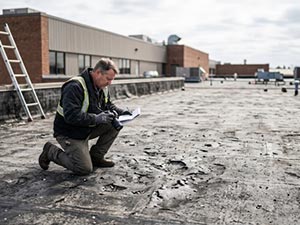
A technician works through five zones in the following order: the open membrane, the seams, every flashing detail, the rooftop equipment, and the drainage.
The roof surface is checked for punctures, blistering, surface wear, and the dirt rings that mark where water stands. Seams and laps come next, since separation begins there, followed by curbs under rooftop units, pipe penetrations, skylights, and perimeter edge metal.
Drains and scuppers close out the walk. Blocked drains, damaged clamping rings, and debris around the sump become apparent here, and these issues can explain ponding problems on an otherwise sound roof.
Thermal Imaging in Commercial Roof Inspections
A thermal camera reads surface temperature, and wet insulation releases stored heat more slowly than dry insulation does, so saturated areas appear as distinct patterns after a sunny day.
This matters because moisture spreads well beyond where it entered. A single opening at a seam can leave a wet area many times its size, and none of it is visible from above.
Timing is part of the method. The scan is performed after sunset following a sunny day, when the roof is giving off heat and the contrast between wet and dry areas is easiest to read.
Commercial Roof Inspections End with a Written Record
A useful inspection report contains four things: dated photographs, a roof plan marking each finding, condition notes on the membrane and details, and the thermal results.
Findings are sorted by urgency, separating what needs repair now from what should be watched and what is simply normal wear for the age of the system.
That document becomes the baseline. The next inspection can be compared against it, which is how an owner learns whether a condition is stable or changing.
Inspection reports also have value beyond roof maintenance. Lenders, insurers, and buyers all ask for current condition documentation during a transaction.
Commercial Roof Inspections Give Owners a Clear Picture
Roof decisions get much easier when they rest on documented conditions instead of guesswork, and thermal scanning helps turn an assessment of the roof into documented findings.
Thorough Commercial Roof Inspections
Our inspections feed directly into a maintenance program, so findings become scheduled work rather than a list that sits in a drawer. For commercial roof inspections in Elizabethtown, KY, contact Commercial Roofing Pros at (857) 663-7767 today.
FAQ
How often should a commercial roof be inspected?
Twice a year is standard: once in spring and once in fall, with an additional inspection after severe weather. Roofs with heavy equipment traffic often need more.
How long does a commercial roof inspection take?
Most inspections take a few hours, depending on the roof size and the number of penetrations. Thermal scanning adds an evening visit, since the surface needs to release heat after sunset.
Do I need to be on site during a roof inspection?
No. Roof access and a short conversation about known trouble spots are enough, and the findings arrive in the written report afterward.